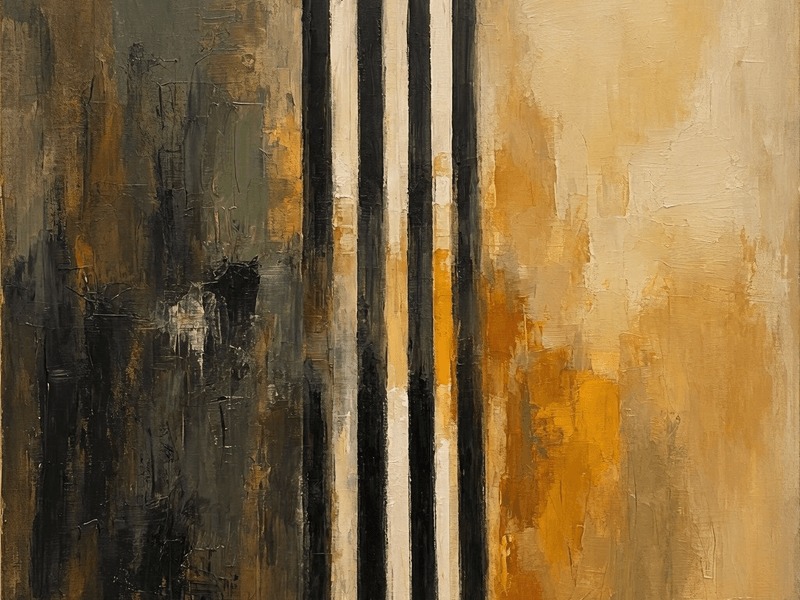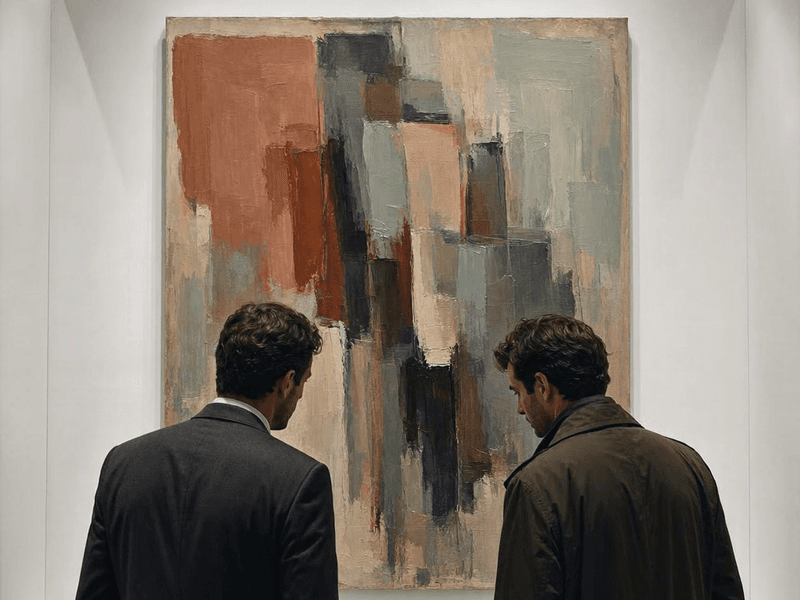
A painting the size of a door is standing in a room somewhere, and you are looking at a thumbnail of it while waiting for coffee. The thumbnail is bright, legible, and slightly wrong. It has been cropped by a stranger, compressed by a server, sorted by a machine, and delivered to your palm at the size of a playing card. You feel that you have seen the painting. You have not. You have seen its ghost, dressed for a different party.
This is not a complaint about screens. This magazine lives on screens. The argument is narrower and, I think, sharper: the feed is a genre. It has conventions, appetites, a grammar. It rewards certain gestures and starves others. To treat it as a transparent window onto art is the same category error as treating a film still as the film. The still is beautiful. The still is not the thing.
Consider what the square crop actually does. It amputates the periphery, which is often where a painter has been arguing with themselves. It flattens the relationship between figure and edge, which is frequently the whole drama. It equalizes scale, so that a mural and a postcard arrive at your eye as siblings. It privileges centered composition, high contrast, and a punchline in the middle third. Work made for the body — work whose meaning depends on you stepping back, stepping closer, walking around, feeling the room cool as you approach — is asked to perform in a format designed for a face at arm's length. Most of it cannot. The work that can is not necessarily the best work; it is the work best suited to a specific aspect ratio.
Then the swipe. The swipe is a verdict rendered before cognition. It is the eye's reflex trained into a thumb. Anything that requires more than a second of orientation is discarded not because it failed but because it asked. Slowness reads as noise. Ambiguity reads as error. The swipe is not neutral time; it is aggressive time, time weaponized against duration. A painting that unfolds over ten minutes of standing has no ten minutes to unfold. It has, generously, a breath.
And the algorithmic sort, which is the most quietly ideological of the three. The sort does not show you what exists. It shows you what resembles what you have already stopped for. It builds a corridor of taste around you and calls the corridor the world. Inside that corridor, certain palettes multiply. Certain surfaces — glossy, saturated, high-key, camera-friendly — accumulate gravity. Certain subjects, having proven their swipe-resistance, become templates. The sort is not a curator. A curator argues with you. The sort agrees with you until you no longer remember what disagreement felt like.
Here is where the consequences begin, and where technophobia would be a lazy reading. The problem is not that artists see their work on phones. Artists have always adapted to the reproduction technologies of their moment; the postcard, the slide carousel, the glossy catalogue each rewrote studios in their turn. The problem is that the feed has become the primary rehearsal space for reception. Work is now often conceived, at some level, for its thumbnail. Studios organize themselves around the moment of capture. The wall label is written for the caption. The scale is chosen for the crop. This is not corruption; it is adaptation. But it is adaptation to a genre, and the genre has a very specific idea of what art should feel like, which is: legible in one second, striking at four inches, and friendly to a machine that cannot see.
What gets lost is not mystery in the mystical sense. What gets lost is the physical argument a work makes with its viewer's body. The subtle warp of a canvas that has moved with humidity. The place where the paint gets thin and you can see the artist hesitating. The smell of a material that will never travel through fiber optics. The way a sculpture reorganizes the room's acoustics. The way a video installation uses darkness as a co-author. These are not premium features. They are, in many cases, the work itself. The feed does not suppress them out of malice. It simply cannot carry them, the way a telephone cannot carry a handshake.
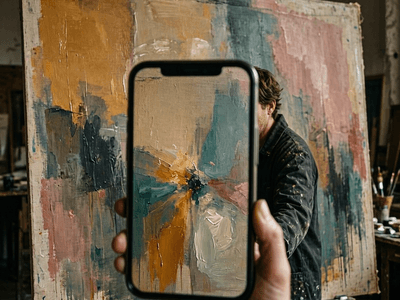
There is a second casualty, less discussed: the viewer's own body. To look at art in a room is to be looked back at by the room. You become aware of your height, your pace, your breath, the strangers around you also looking. Meaning happens in that mutual awareness. The feed offers looking without being looked at, judgment without exposure, connoisseurship without risk. It is criticism in pajamas. Something in the ethics of attention rots when the object cannot, in any sense, notice you.
None of this is an argument for pilgrimage as the only legitimate mode. Most people cannot fly to biennials, and the democratization of access through the screen is real and worth defending. The argument is that access is not the same as encounter, and that pretending otherwise degrades both. A photograph of a painting is a photograph. A clip of a performance is a clip. They are genuine artifacts, sometimes lovely ones, occasionally superior to the source. They are not the work. When we forget this, we start grading paintings on how well they photograph, which is roughly as sensible as grading novels on how well they fit on a billboard.
So what would honesty look like. It would look like admitting that the feed is a medium with its own masterpieces and its own mediocrities, and criticizing it on its own terms rather than smuggling it in as documentation. It would look like writing about exhibitions we have actually stood inside, and being frank when we haven't. It would look like artists who make feed-work and gallery-work and refuse to pretend they are the same object. It would look like readers who understand that a scroll through a fair is a trailer, not the film, and who reserve the right to be surprised, in person, by what the trailer misled them about — in either direction.
The feed will not go away, and should not. But it is time to stop calling it seeing. Seeing is what happens when a body meets an object in a room and neither of them can swipe. Everything else, however useful, however seductive, is a different verb, and deserves a different word.