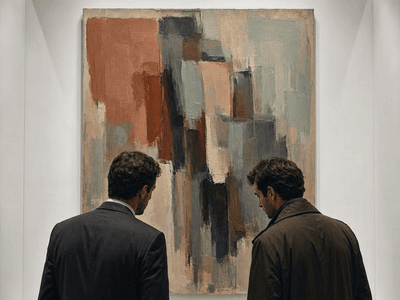
Walk any convention hall in any season and you will find the same room repeated a thousand times: three metres by four, drywall skinned in matte white, a grid of track lights burning at a colour temperature invented to flatter jewellery. This is the booth. It is the dominant exhibition form of our era, more common now than the museum wall or the artist-run project space, and it is quietly disastrous for everything it contains.
The booth pretends to be neutral. That is its first lie. A room this small, this bright, this hemmed in by two similar rooms and a carpeted aisle, is not a container but a compressor. It squeezes the work into a legible thumbnail. Painting becomes signature. Sculpture becomes silhouette. Installation, which needs air the way a swimmer needs water, becomes prop. Whatever the artist made in the studio — slow, wrong, unresolved, alive — arrives here already translated into the grammar of the transaction: recognisable, portable, insurable, done.
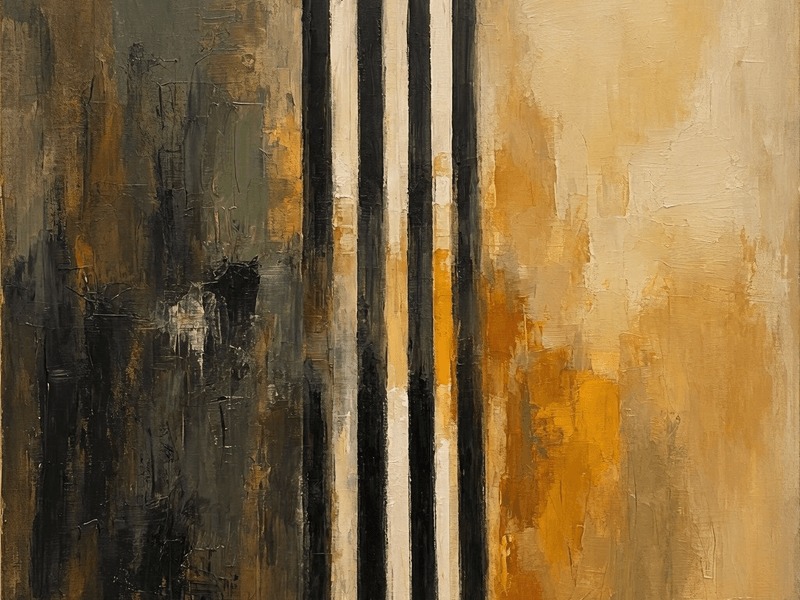
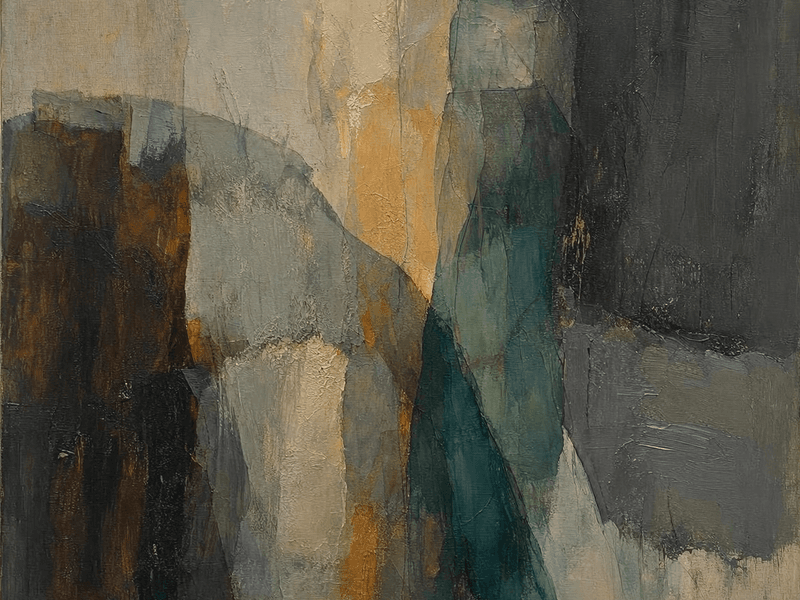
Consider what track lighting does to a painting. Studio light is weather; gallery light, at its best, is a room's own breath; museum light is architecture. Fair light is surgery. It hits the surface from a fixed angle designed to eliminate ambiguity, and ambiguity is where painting actually lives. Impasto flattens. Glazes go plastic. A canvas built over months to hold a specific dusk becomes an object under interrogation. The buyer sees clearly. Clarity, in this context, is a form of violence.
Installation fares worse. An installation requires threshold — the moment you step out of one condition of attention and into another. The booth has no threshold. It has an opening onto an aisle onto another opening. You do not enter; you glance sideways while walking somewhere else. The work becomes stage set for the gallerist's handshake. Wall-based reliefs, screens, sculptural assemblages: all reduced to backdrop, all understood before they are seen. What was meant as an environment becomes a window display, and window displays are read, not inhabited.
Even video, which one might think impervious because it carries its own darkness, loses. The booth cannot dim. It cannot quiet. It cannot ask you to sit. So video is either muted and looped as decoration, or shunted into a curtained closet that everyone declines to enter because the aisle is where the deals are happening and the closet is where the deals are not. The medium's most patient artists are punished for making work that asks for time.
And then there is attention itself, which the fair treats as a renewable resource and depletes like a mine. A visitor moves through hundreds of these rooms in a single afternoon. Each demands the same posture: pause, scan, nod, move. The eye learns to shop. It learns to accept the frame the booth provides — one artist, one price point, one aesthetic position, tidily bounded — as the natural unit of art. It stops asking why this next to that, why now, why at all. The booth trains us out of the questions that make looking worth doing.
The defenders of the form say: but the fair funds the ecosystem. Without it, no galleries; without galleries, no artists; without artists, no art. This is the argument of every efficient machine ever built. It is also, on inspection, a description of dependency, not health. A field that can only survive by submitting its objects to the worst possible viewing conditions six or eight times a year has not solved its economic problem; it has agreed to a permanent aesthetic tax. The tax is paid by the work.
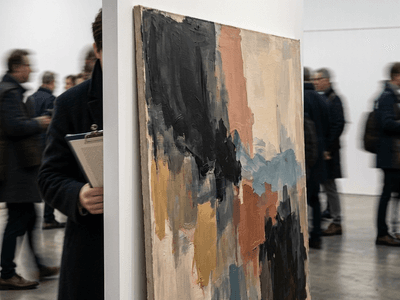
Notice what thrives in the booth and what withers. What thrives: the mid-scale canvas with a strong central image, high chroma, one clear gesture. The photogenic sculpture at eye level. The wall piece that reads in three seconds and reproduces well on a phone. What withers: the very large, the very small, the very slow, the very quiet, the work that needs a corner it doesn't have, the work that needs a wall it can't have, the work that needs you to come back tomorrow. Over years, over decades, this selection pressure does not stay on the fair floor. It walks back into studios. Artists, being human, begin to make what the booth can hold. The room writes the work.
The honest response to this would be to build a different room. Some galleries try. They knock down the interior walls of their allotment, hang a single object, refuse the grid. It helps and it doesn't. The aisle is still an aisle. The neighbour still has track lights. The clock on the transaction still ticks. A single well-hung booth in a hall of a thousand is a monk in a casino: admirable, and swallowed.
The deeper problem is that the booth is not a room but a genre. It has conventions the way the sonnet has conventions, except no one admits it is a form, and so no one writes against it. Everyone pretends the white cube of the fair is the same as the white cube of the gallery is the same as the white wall of the museum, when in fact each is a different instrument tuned to a different frequency, and the fair's frequency is the highest and thinnest and least capable of carrying complex signal. To speak of art seen at a fair as though one has seen the art is a category error we have all agreed to make.
What would it mean to refuse? Not to boycott — moralism is boring and mostly for people who can afford it — but to stop mistaking the booth's verdict for the work's. To understand that whatever you saw in that twelve-square-metre room was a compressed file, and the full resolution lives elsewhere: in a studio, in a slow room, in a book made carefully, in a conversation that lasts longer than a handshake. The fair is a directory, at best. It is not the library. It is certainly not the reading.
The booth will not go away. It is too efficient, and efficiency is the century's only remaining aesthetic. But we can stop pretending it is neutral, stop pretending it is generous, stop pretending the light is good. We can name it what it is: a room built to sell, which does its job, and which does nothing else well. Everything else — the looking, the thinking, the being changed — happens somewhere the aisle cannot reach.