There is a particular silence in a young artist's studio at the end of the month. It is the silence of arithmetic. Rent, stretcher bars, a litre of medium, the electric bill, the modelling fee for the friend who sat three afternoons in a row. The work on the wall does not pay these things. Someone, somewhere, writing a cheque, pays these things.
That cheque is what we are actually talking about when we talk about collecting emerging art. Not taste. Not discovery. Not the small vanity of having been early. A cheque, cashed, converted into another month of the artist continuing to exist as an artist. Everything else is theatre we perform around the act to make ourselves feel less exposed.
I want to argue for the exposure.
The going script for the two-thousand-dollar collector is borrowed, almost word for word, from a different industry. It speaks of portfolios and positions, of watching and waiting, of a career one is buying into rather than a person one is buying from. It flatters the buyer as a kind of junior analyst of culture, someone whose eye is also a ledger. It is a script written to make spending money on art feel adult, by which we mean: recoverable.
This is the framing I am asking you to abandon. Not to argue with, not to complicate, not to hedge against. Abandon.
Consider instead the person who buys a season ticket to a small theatre in a city that barely deserves one. She does not expect the ticket to be worth more in April than in October. She expects the theatre to still be there in April. That is the entire structure of the exchange. She has agreed, quietly, that a portion of her income will go toward the continued existence of a thing she wants to continue to exist. When the lights come up she is not richer. She is, in some difficult-to-name way, less alone.
Or the person who subscribes to a small press that publishes six titles a year in editions of eight hundred. She receives books, yes, and reads some of them, and lends others, and forgets a few on the shelf. But the books are not the point. The point is that a press exists which prints those books, and that the press exists partly because she pays for it to. She is not accumulating. She is sustaining.
This is the register in which the purchase of a two-thousand-dollar painting from a twenty-eight-year-old should be understood. It is closer to a subscription than to an acquisition. It buys studio time. It buys the specific afternoon on which the artist does not have to take a shift, and instead stays with a canvas that is not working, and finds out why it is not working. It buys the next canvas, which may be the one that matters, and which will not exist if the previous month did not.
We are unused to speaking this plainly about money and art because plainness sounds like sentimentality, and sentimentality is the one thing the contemporary collector is trained to fear. Better to sound cold. Better to sound like one is placing a bet. The language of the bet protects the buyer from the more embarrassing possibility that she cares about the artist's life.
But she does. That is why she is in the studio on a Saturday, holding a paper cup of bad coffee, looking at four small paintings and a large one, and trying to decide. She is not there because she has run the numbers. She is there because she followed a link, saw an image, felt the specific interior lurch that means something has occurred, and travelled across the city to stand in front of the source of it. Everything after that moment is her attempting to translate the lurch into a permissible reason to spend.
My suggestion is that she stop translating.
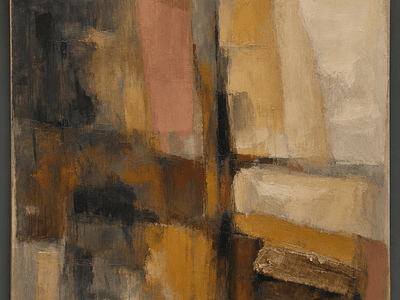
The permissible reason is: I would like this person to keep working. I would like the conditions of their working to be, this month, marginally less brutal. I would like the studio to still be rented in six months. I have two thousand dollars I can part with without harming my own life, and I am parting with it, and in exchange I am taking home an object that was made by the hands of the person whose continued working I have just made marginally more possible. The object is not the transaction. The object is the receipt.
This reframing does two things at once. It dignifies the buyer, who is no longer pretending to a competence she does not have and does not need. And it dignifies the artist, who is no longer being asked to perform as a small enterprise with projected earnings, but is instead being recognised as what she is: a person doing difficult work under conditions that are almost always harder than they look from the outside.
There is a further honesty required, and it is the one most buyers flinch from. The money may not come back. Not in any form. The painting may hang in your hallway for thirty years and be inherited by a nephew who does not want it. The artist may stop making work in three years and become a landscape gardener, and be happier for it. The gallery that represents her may close. None of this should alter the ethics of the original cheque, because the original cheque was not written against any of these outcomes. It was written for a month of studio rent that has already been paid, for a stretcher already built, for an afternoon of work that has already happened and cannot be undone by anything the future does.
This is the same contract one signs with the theatre and the press. The performance happened. The book was printed. The fact that the theatre later closed does not retroactively empty the seat you sat in. You were there. It was there. You paid for it to be there. That is the whole shape of the thing.
I am aware that this argument makes the emerging-art market sound less exciting than it is often sold as being. Good. It should sound less exciting. It should sound like a civic practice, undertaken by people who have decided that a city with working artists in it is a city they would prefer to live in, and who are willing to pay, modestly and repeatedly, for that preference to be a fact rather than a wish.
Write the cheque. Take the painting home. Hang it somewhere you will see it in the morning. Do not check on it. Do not look it up. Let it be what it already is: proof that on one specific afternoon you chose to keep a stranger at their work, and they let you take home the evidence.