Nairobi arrives in the Athenoir index the way weather arrives: all at once, from every direction, unignorable. One hundred and sixty-five emerging artists sit under the city's name in our research database. That is more than Istanbul's 155, more than Jeddah's 107, more than Tel Aviv, Riyadh, Dubai, Lagos, Tokyo, Dakar, Shanghai, Accra. It is more than any single city contributes to our emerging tier, anywhere on the planet. London does not put up this number. New York does not put up this number.
And yet the collecting architecture that ought to correspond to a bench this deep is, by any honest measure, not there. No blue-chip primary market of the kind that metabolises this many practices. No dense gallery mile. No local auction ecology that speaks to the work being made. The largest emerging-artist cohort in our entire index of 7,764 is assembling in a city whose formal apparatus for absorbing it is closer to a village than a capital.
That is the thesis. Nairobi is where the mismatch is loudest.
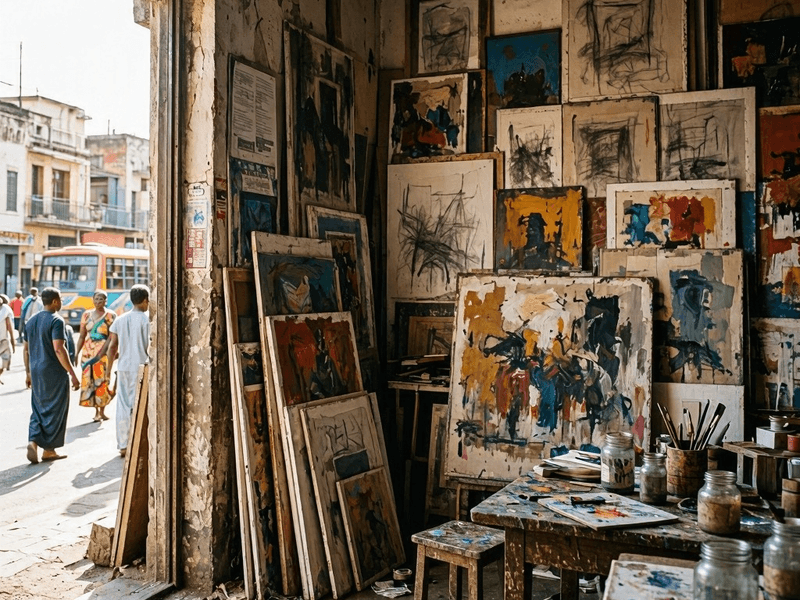
Walk any afternoon through the Ngong Road corridor or out toward the industrial edges of the city and the density resolves into something specific: converted warehouses, courtyard studios shared four and five ways, printmaking beds pushed against walls that were painted last week. The Athenoir index reads emerging practice, across all cities, as a pluralist thing — 268 installation practitioners, 250 painters, 241 who draw, 238 in mixed media, and, tellingly, 213 working in sound and 212 in AI-based work, 209 in generative systems, 209 in video. The established tier of our database, by comparison, is still overwhelmingly painting and sculpture: 130 painters, 69 sculptors, and the newer disciplines barely cracking thirty. The generational shear is global. In Nairobi it is spatial. You can stand in one building and hear it.
What the city has instead of infrastructure is proximity. Practices sit close enough together that a ceramicist and a generative coder end up sharing a kettle. This is not romance. It is what happens when 165 artists occupy a metropolitan footprint that has not yet been zoned by the market into neighbourhoods of prestige. There is no Chelsea here to price the sound artists out. There is no Mayfair to sort the painters from the video makers. The sorting has not started. That is the window.
The pricing structure, read off the index, tells the second half of the story. Across the entire Athenoir emerging tier, roughly two thousand artists state an entry point below five thousand dollars. The bulk of the remainder sit in the five-to-ten and ten-to-fifty bands. The overwhelming majority of the emerging index — Nairobi very much included — is acquirable below fifty thousand. This is not a claim about value. It is a claim about access. The distance between a serious early-career practice and a serious early-career collector, measured in dollars, has rarely been shorter. Measured in logistics, in Nairobi, it remains considerable. There is no concierge layer. There is no established secondary market to reassure the nervous. A collector who wants in has to actually go.
Going is the guide.
Begin where the city begins its own conversations with itself: the district around Rosslyn and Kitisuru for the quieter studios that have taken over former residential compounds, then south and east toward the older industrial belt where the larger installation practices need the ceiling height. The Athenoir index registers installation as the single most common emerging discipline worldwide, and Nairobi's version of this — often built from salvaged material, often engineered for a specific room rather than a fair booth — makes the case for why square metres matter more than square feet. Ask, when you arrive, who else is upstairs. Someone always is.
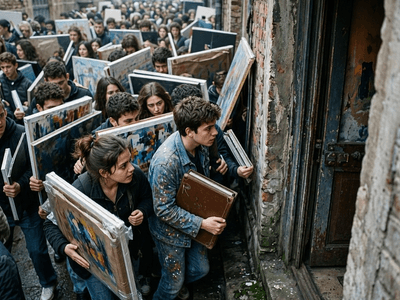
Mid-morning is for the painters and the drawing practices, who tend to keep more conventional hours and whose studios reward slow looking. Painting and drawing sit second and third in our emerging-practice count globally, and in Nairobi both traditions are visibly in dialogue with the printmaking and collage work happening two doors down. Collage — 222 practitioners in our emerging tier — is having a quiet moment across the index, and the Nairobi version of it is unusually literate about surface.
Afternoons belong to the disciplines that are rewriting the established tier from underneath. Sound art, AI-based practice, generative systems, video: in the Athenoir emerging database each of these clears two hundred practitioners. In the established database, none of them do. The generational replacement is not theoretical. It is arithmetic. In Nairobi it means asking, at every studio, whether there is a screen or a speaker you should also be looking at. There usually is. It is usually in another room.
Evenings, do the thing the city rewards: eat somewhere loud, and let whoever you met in a studio bring whoever they were working with. The social layer here is doing the work that, in older markets, is done by fairs and dinners and viewing rooms. It is not a substitute. It is a precondition. The infrastructure will come. It is already being assembled, piecemeal, by the artists themselves — group shows in borrowed rooms, shared documentation, shared shipping.
What to take from all this. Our index does not forecast and this guide will not either. But the descriptive fact is stark enough to sit with. The largest single-city concentration of early-career artists in a global database of nearly ten thousand is currently located in a city whose formal market cannot yet hold it. Either the infrastructure will meet the artists, or the artists will keep leaving to meet the infrastructure elsewhere — and a version of that second story has been running for a decade already, visible in the Nairobi-trained names now showing out of Lagos, Dakar, London, New York.
The first story is the more interesting one. It is also the one a visitor can still, for now, participate in by simply booking a flight and knocking on doors. Bring comfortable shoes. Bring a notebook. Bring the humility appropriate to a city that has organised, largely without help, the deepest bench of emerging practice our researchers have found anywhere. The lighthouse is on. The harbour is still being built. Both facts are true at once, and both are why you go.