The plane banks over the Atlantic and Dakar arrives in ochre: the Cap-Vert peninsula thrust into water on three sides, the medina tight against the corniche, Gorée a smudge to the southeast. It is a city that has always looked outward and been looked at, and it has spent decades deciding, with unusual clarity, who gets to do the looking.
Most art capitals build in a familiar order. Galleries open, artists follow the money, institutions calcify around the trade, and a biennial eventually arrives to launder the whole arrangement into cultural prestige. Dakar did it backwards. The studios came first. Then the collectives. Then the biennial. The commercial gallery layer, such as it is, arrived last and remains the thinnest tier of the ecosystem. This is the single most important fact about the city as an art place, and it explains almost everything else.
The Athenoir index counts 86 emerging artists working out of Dakar. That places the city inside a tight West African bracket with Lagos at 89, Abuja at 90 and Accra at 81 — four cities whose combined cohort rivals any regional cluster in the emerging database. But the cohorts are not interchangeable. Lagos is a market before it is anything else. Accra has built its reputation through a small number of internationally legible rooms. Abuja carries the weight of state patronage. Dakar's 86 sit on a substrate the others do not have: an artist-first architecture whose oldest load-bearing walls are studios and residencies, not showrooms.
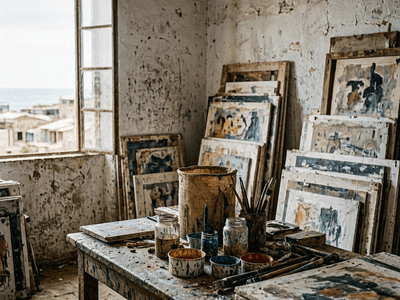
Walk the residential blocks off the corniche and the evidence is domestic. Converted villas with courtyards doubling as sculpture yards. Ground-floor rooms with the shutters flung open to catch the Harmattan light. A city where the phrase atelier d'artiste is not a marketing term but a description of a working room, often a shared one, often with a bed in the corner. The Dakar studio is not a private cathedral. It is a node in a network, and the network is older than any of its individual buildings.
The biennial has been the loudest of Dakar's inventions, but the collective is the more interesting one. Dakar's artist-run structures — some formally constituted, most not — have functioned for decades as informal admissions committees, distribution systems and international agents rolled into one. When a curator arrives from Lisbon or São Paulo or Sharjah, the first stop is rarely a gallery. It is a compound. This is how 86 emerging artists get onto an index like ours without the intercession of a commercial machine designed to produce them.
What do they make. The Athenoir index does not sort by city and practice simultaneously, but the emerging database as a whole tilts toward installation, painting, drawing and mixed media at the top, with photography, sculpture, watercolour, performance, collage and ceramics clustered just behind. Sound art, AI art, generative art and video art form a sizeable digital tier of their own. Dakar's cohort reads legibly against this distribution. The painting tradition is deep, the sculptural and textile-adjacent practices are strong, and there is a growing sound and moving-image presence that speaks to the city's long relationship with music and with francophone experimental cinema. What Dakar does not have, and does not seem to want, is a monoculture. No single medium dominates the way painting dominates certain other capitals on the index.
Prices, when they surface, are legible. Across the full Athenoir emerging database, roughly 2,000 artists list a lower bound under $5,000, and the great majority of the index sits below $50,000 at entry. Dakar's cohort tracks this pattern rather than defying it. The point is not that work is cheap. The point is that the pricing culture in Dakar was set by artists in dialogue with a small international curatorial class, not by a domestic gallery scene competing to inflate its own inventory. Numbers here mean what they say.
The city rewards a specific kind of visit. Fly in without appointments and you will see very little. Fly in with three introductions and you will not sleep. The introductions are the key that opens the compound gate, and the compound is where the work lives. First-time visitors often misread the quiet of the commercial streets as an absence of activity. It is not. It is the sound of an art economy that does not need shop windows.
Gorée should be walked once, early, and then set aside. The island is a site of historical gravity so total that it flattens contemporary reading. Better to spend the second day in the northern neighbourhoods, where studio doors open onto streets that smell of grilled fish and diesel, and where the conversations that shape the next Dakar cohort are actually happening. Better still to time a visit to the biennial's off-season, when the international traffic thins and the city returns to its own rhythm.
There is a temptation, writing about Dakar from outside, to frame the city as a discovery. It is not. It has been legible to those paying attention for at least three decades. What has shifted is the width of the audience. The Athenoir index puts Dakar inside a global emerging conversation that runs from Nairobi's 165-strong cohort through Istanbul, Jeddah, Tel Aviv, Casablanca, Lagos and Accra — a Middle East, Africa and Asia axis that together forms the majority of the emerging database. Dakar's position in that axis is structural, not accidental.
The question the city poses to other emerging capitals is uncomfortable and worth stating plainly. If the studios and the collectives and the biennial can precede the galleries, and the resulting cohort can hold its own against cities with far denser commercial layers, what exactly is the commercial layer for. Dakar does not answer the question. It simply keeps working, artist-first, and lets the 86 names on our index answer it by continuing to exist.
Go for the light off the Atlantic at four in the afternoon. Go for the compounds. Go because the order in which a city builds its art world is a moral question, and Dakar answered it a long time ago.