The ferry crossing from Karaköy to Kadıköy takes twenty minutes and traverses two continents, three tax regimes in the artists' heads, and roughly a century of unresolved argument about where this city belongs. Nobody on the boat is looking at the water. They are looking at their phones, at studio rents in Fikirtepe, at a group show opening in Yeldeğirmeni, at the euro rate, at the lira rate, at a collector's DM from Riyadh.
Istanbul is the second-largest emerging cohort in the Athenoir index: 155 artists tracked at early-career stage, behind only Nairobi's 165 and ahead of Jeddah, Tel Aviv, and its own domestic sibling Ankara, which holds 101. Add Ankara and the smaller Anatolian nodes and you have a Turkish corridor of more than 250 tracked emerging practitioners. That is not a scene. That is an industry with the metabolism of a scene and the output of a mid-sized European country.
What the number does not tell you is the geography of the pressure. To the west, an art world that once treated Istanbul as its most exotic legible port has spent a decade quietly withdrawing budgets, biennial commissions, and residency slots. To the southeast, a Gulf art economy is expanding with unnerving speed, opening museums and fairs, offering fees in dollars, absorbing curators. Istanbul sits between these two gravitational fields and belongs fully to neither. It is close enough to Europe to be legible to a Berlin curator on a weekend flight, close enough to the Gulf to be a natural stop on a Riyadh–Doha–Sharjah acquisition tour, and far enough from both that no one has yet decided what it is for.
The artists have decided. They are working.
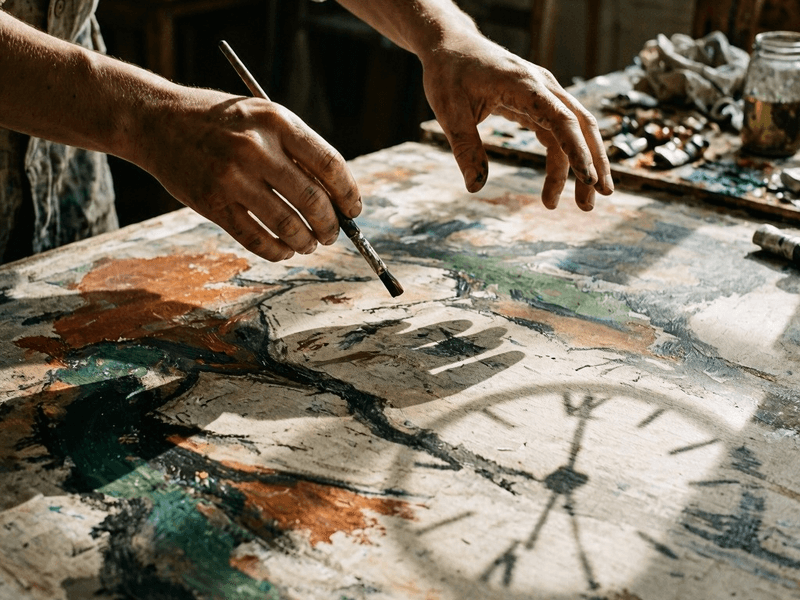
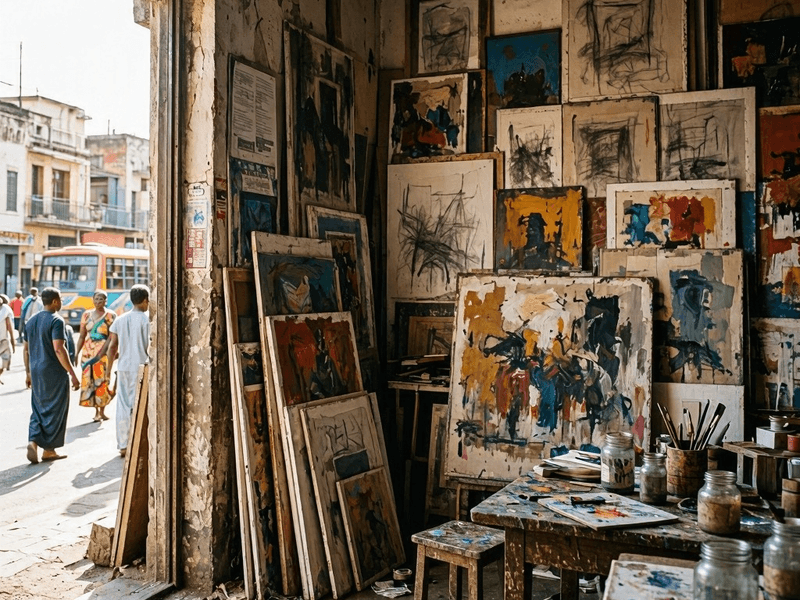
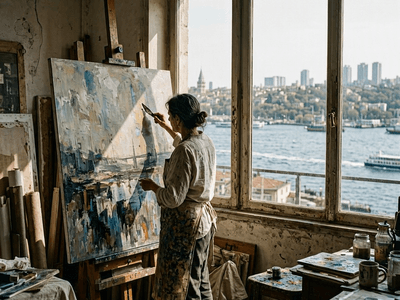
Walk the studios strung along the Golden Horn, the converted mechanical workshops in Dolapdere, the top floors above the fabric wholesalers in Kadıköy, and you notice the same thing you notice in the Athenoir index itself: practice here is promiscuous. In the emerging database globally, installation leads at 268 artists, painting at 250, drawing at 241, mixed media at 238, and the digital practices — sound art, AI art, generative art, video — sit only a step behind, each with over two hundred practitioners. Compare that to the established database, where painting alone dwarfs everything at 130 and sculpture trails at 69, and you can feel the tectonic shift. Istanbul embodies it perfectly. A painter here almost always also builds, films, records, codes. The single-medium career is a European inheritance that the younger generation has quietly stopped paying rent on.
This is not eclecticism for its own sake. It is a response to a specific economic weather. When your currency has lost most of its purchasing power against the dollar in a decade, when a canvas costs what it costs but a collector abroad pays in euros, when a residency in Amsterdam pays a month's Istanbul rent for a week's work, you learn to hold several practices at once because you are already holding several economies at once. The work absorbs the condition. Sound pieces made on borrowed equipment, video shot on the phone, ceramic experiments fired at a friend's studio in Kütahya, oil paintings sold to a visitor from the Gulf who came in for the weekend — all of it, often, by the same person, in the same year.
The prices reflect this porousness. Across the Athenoir index, roughly two thousand emerging artists globally state a lower bound under five thousand dollars, and the majority of the entire emerging index is accessible below fifty thousand. Istanbul sits comfortably inside that geometry. A first work by a serious early-career practitioner here can be acquired for the cost of a business-class ticket to the fair where you would otherwise not see them. The city is one of the last major production centers in the Mediterranean basin where entry-level acquisition still functions as an act of attention rather than an act of triage.
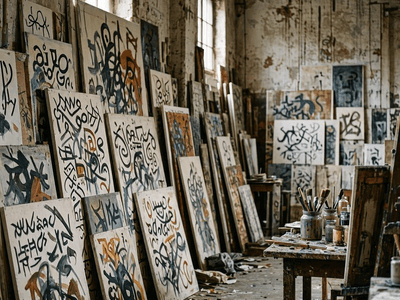
Attention, though, is the scarce resource. Istanbul has an unusually mature institutional layer for a city that international press still occasionally calls emerging — private museums along the Bosphorus, a long-running biennial, foundation spaces, artist-run project rooms that outlast their funding. It has an unusually thin critical layer. Writing about art in Turkish is done largely for love, in Turkish, for a readership that overlaps almost entirely with the artists themselves. Writing about it in English is done for foreign editors on foreign deadlines, which means the version of Istanbul that reaches the wider art world is always a translation of a translation. The 155 artists in our index are the ones who have managed to cross that gap. Behind them stand many more who have not, and whose work is no less serious.
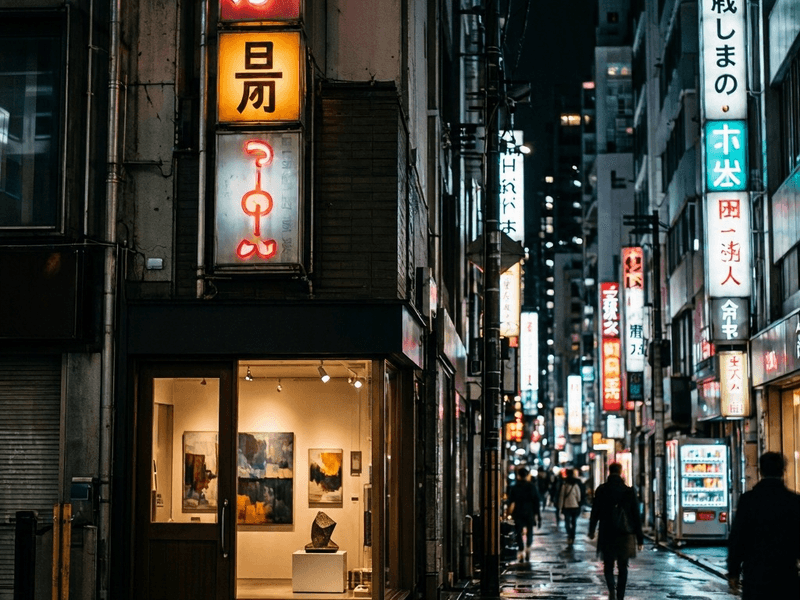
The practical map, for a visitor with three days and honest intentions: start in Beyoğlu, walk down through the galleries around İstiklal and Tophane, cross to Karaköy, take the ferry, spend the afternoon in Kadıköy and Yeldeğirmeni, come back at night. The second day belongs to Dolapdere and the museum cluster, the third to whichever studio has agreed to let you in. Do not skip the studio. The Istanbul that matters is not on the gallery walls yet. It is on the floor of a workshop where someone is stretching linen and thinking, correctly, that Berlin is not paying attention and Riyadh has not yet arrived.
That interval — after European curiosity has thinned and before Gulf capital has fully landed — is the working condition of the city right now. It will not last. Something will resolve, or fail to resolve, in the next few years, and the Athenoir count of 155 will look either like an early reading of a scene that grew into itself or like a snapshot of a peak. The artists working through it are not waiting to find out. They are producing at a rate that suggests they have understood something the rest of us are still catching up to: that belonging to no one, for a moment, is the same thing as being free to work.
The ferry going back is emptier. The Bosphorus at night is black and moves faster than you expect. Somewhere on the European side a gallery is closing up, somewhere on the Asian side a studio light is coming on, and the city continues its long argument with itself about which direction the work is facing. The honest answer, from the water, is both.