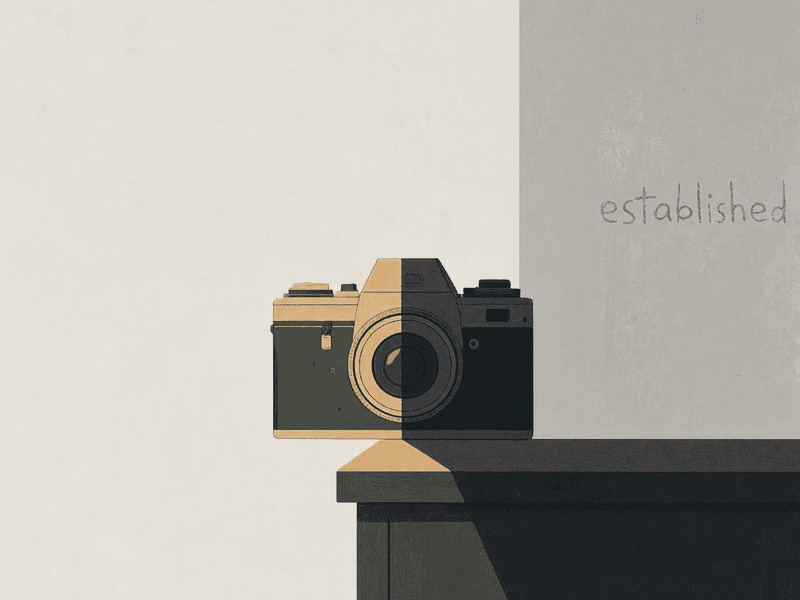
Somewhere between the last art fair and the next one, the arithmetic of the emerging field tipped. In the Athenoir index, installation is now the single most common practice among emerging artists, logged 268 times across a database of 7,764. Painting, the medium the entire commercial apparatus was designed around, sits at 250. The margin is narrow. The implication is not.
Cross the threshold into the established tier and the numbers invert with almost comic violence. Among the 1,643 established-tier artists in our research index, painting appears 130 times. Installation appears 58. More than two to one, in favor of the rectangle on the wall. The generation the market has already absorbed paints. The generation arriving does something else.
The practices clustered behind installation in the emerging index tell the same story from different angles. Drawing at 241. Mixed media at 238. Photography at 234. Sculpture at 232. Performance at 223. Sound art at 213. AI art at 212. Generative art at 209. Video at 209. These are not fringe categories inside the youngest cohort; they are the cohort. An emerging artist in the Athenoir index is now roughly as likely to work in sound as in watercolor, and more likely to make an installation than a painting.
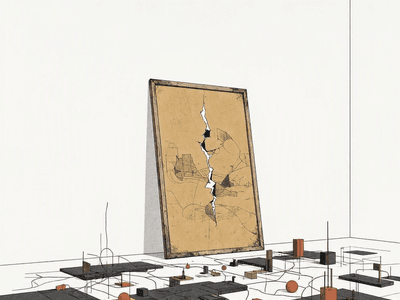
What the market's existing machinery is good at is the object that ships, hangs, insures cleanly, photographs well in a booth, and resolves into a domestic wall behind a sofa. Painting is the format that satisfies all five conditions simultaneously. Sculpture satisfies four. Installation, in its honest form, satisfies none. It is site-dependent, labor-intensive to reinstall, awkward to crate, ambiguous to insure, and frequently impossible to live with in the room where people also eat dinner.
This is the gap. The established tier reflects decades of selection pressure exerted by that infrastructure: the artists who survived commercially were disproportionately the ones whose practice fit the freight container and the collector's hallway. The emerging tier reflects what artists are actually choosing to make, before the filter has been applied. And what they are choosing, in aggregate, is work the filter is engineered to reject.
The geography sharpens the point. The largest emerging cohorts in our research index are not in the cities whose commercial grammar defined the twentieth-century primary market. Nairobi leads at 165 artists. Istanbul follows at 155. Then Jeddah at 107, Tel Aviv and Ankara at 101 each, Riyadh and Abu Dhabi at 96, Dubai at 95, Alexandria and Beirut at 90, Lagos at 89, Doha at 88, Tokyo and Casablanca at 87, Dakar at 86, New Delhi and Cairo at 84, Shanghai and Sharjah at 83, Accra at 81. The Americas account for 1,583 records in the emerging index. The Middle East, Africa and Asia, taken together, form the majority. The cities producing the largest volumes of emerging artists are, in many cases, cities whose local infrastructure was never fully organized around the blue-chip painting circuit to begin with. The absence of that legacy grammar is not a deprivation. It is a permission.
An artist in a city without a dense secondary market has less structural incentive to produce for one. A studio in Lagos or Alexandria or Dakar is not organized around what will resolve into a Basel booth in four years. It is organized around what the artist wants to make and what the immediate context can hold: a room, a courtyard, a screen, a speaker, a temporary site. Installation, sound, video, performance, generative work — these are practices that assume a context other than the collector's living room, because the collector's living room was never the operative horizon.
Meanwhile the price data cuts against the reflex to describe this as a rarefied problem. Roughly two thousand artists in the emerging index have entry points below five thousand dollars. The bulk of the remainder sit in the five-to-ten and ten-to-fifty thousand bands. The majority of the emerging field is accessible below fifty thousand dollars, a substantial minority below five. The supply is not scarce and it is not expensive. It is simply the wrong shape for the room.
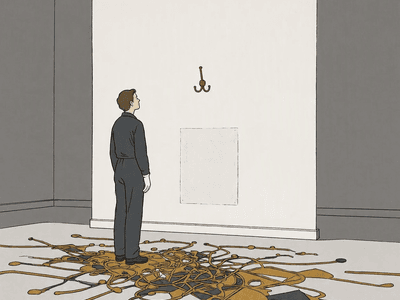
So the question is procedural rather than aesthetic. What does a market do when its supply stops fitting its infrastructure?
Historically it does one of three things. It ignores the mismatch and continues to transact on the shrinking subset of new work that still fits the old container — which is roughly what the two-to-one painting ratio in the established tier suggests has already been happening for a generation. It retrofits the container, slowly and expensively, through institutional acquisition programs, biennial commissions, and the small number of galleries willing to warehouse an installation between showings. Or it builds new containers: hybrid spaces, long-duration presentations, digital custody frameworks, edition structures that decouple the work from a single physical instance.
All three responses are visible in the field right now, and none of them is at scale. The established commercial machinery — the fair booth, the freight quote, the domestic wall — remains overwhelmingly optimized for the practice that ranks second in the emerging index, not first. The mismatch is not a crisis of taste. It is a logistics problem the sector has been slow to name.
There is also a quieter consequence, which is that a rising share of the most ambitious work being made by artists under forty will not enter private collections in any conventional sense, because it cannot. It will exist in institutional custody, in documentation, in reinstallation contracts, in the memory of the people who stood inside it. The commercial record of this generation, if the infrastructure does not adapt, will systematically under-represent what the generation actually made. The painting numbers will keep looking healthy. The installation numbers will keep looking marginal. The reality on the studio floor will keep drifting further from both.
The Athenoir index is a snapshot, not a verdict. But the snapshot is unambiguous on one point. The youngest tier of the field is producing, in its largest single category, work that the market's existing walls, booths, crates and living rooms are least equipped to absorb. Painting has not been dethroned. It has been quietly outvoted by everything else, and the room has not yet looked up from the catalogue.