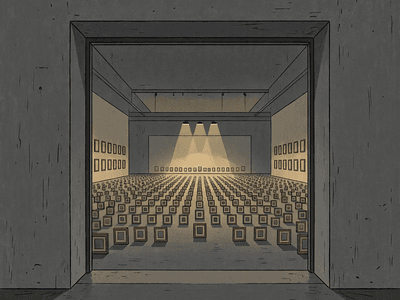
The contemporary art market has a publicity problem, and the problem is that its publicity works. Ask a stranger to picture the market and they will picture an auction paddle, a nine-figure hammer, a warehouse in Geneva. They will picture, in effect, forty-three people. That is the size of what our research index calls the Ultra-Blue-Chip tier: forty-three names, out of 9,407 tracked artists, who set the visual grammar of the entire field for anyone reading a newspaper.
The Athenoir index exists to describe the other 9,364.
Start with the shape of the thing. Our research index holds 1,643 established-tier artists — the Ultra-Blue-Chip forty-three, then 543 Blue-Chip, 616 Established, 441 Mid-Career — and 7,764 emerging artists beneath them. That ratio alone should reorganise the conversation. For every artist whose price is a matter of press release, there are almost five whose price is a matter of studio visit. The pyramid is not steep. It is a plateau with a spike.
Now the number that ought to end certain arguments for good. Of those 7,764 emerging artists, roughly two thousand list entry prices — the lower bound of their own stated range — under $5,000. The bulk of the remainder sit in the $5,000–$10,000 and $10,000–$50,000 bands. In other words, the majority of the emerging index is purchasable, today, at prices lower than a great many people spend on a sofa, a watch, a bathroom renovation, a weekend. This is the market's actual center of gravity, and it is four orders of magnitude away from the number the market is famous for.
This is not a discount. It is not a secret. It is the ordinary price of contemporary art made by living people who are not yet, and may never become, brands. Treating it as scandalous or as opportunity are two versions of the same misreading. The correct word is access.
Access to what, and from where. The geography of our emerging index is the second demystification. The Americas account for 1,583 artists — substantial, but no longer dominant. The Middle East, Africa and Asia, taken together, form the majority. The largest single city cohorts in our research index read like a corrective to any map drawn in the 1990s: Nairobi 165, Istanbul 155, Jeddah 107, Tel Aviv 101, Ankara 101, Riyadh 96, Abu Dhabi 96, Dubai 95, Alexandria 90, Beirut 90, Lagos 89, Doha 88, Tokyo 87, Casablanca 87, Dakar 86, New Delhi 84, Cairo 84, Shanghai 83, Sharjah 83, Accra 81. Nairobi leads. Read that sentence again. The emerging market's densest city, by our count, is Nairobi, and it is followed by a run of Turkish, Gulf, Levantine and West African capitals before a single Western city appears.
What a collector encounters at the entry price, then, is not a discounted version of the auction room. It is a different market entirely, with a different center, a different language, and a different set of practices. Our research index shows the emerging tier distributed across installation (268), painting (250), drawing (241), mixed media (238), photography (234), sculpture (232), watercolor (230), performance (223), collage (222), ceramics (211), sound art (213), AI art (212), generative art (209), video art (209). Painting is present but not sovereign. The established tier, by contrast, remains painting-first — 130 painters, then 69 sculptors, 58 installation artists — a reminder that the auction economy still rewards the object that hangs flat on a wall.
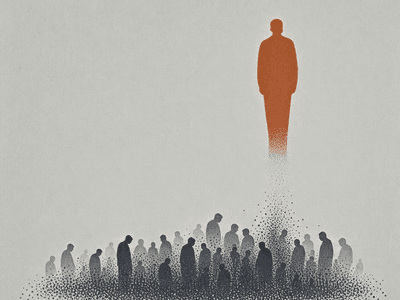
The emerging economy does not. It rewards, or at least contains, the artist who works in sound, in code, in performance, in ceramic, in the specific humidity of a specific city. It is a wider practice map than the one above it, and it is priced for people, not funds.
Which brings us to the word that ought to replace the tired vocabulary of the market: patronage. Patronage is what happens when a person with some money and some conviction gives a working artist the ability to keep working. It has nothing to do with the secondary market and nothing to do with the auction record. At $2,800 for a drawing, $4,500 for a photograph, $12,000 for a ceramic floor piece, patronage is what a mid-level professional salary can sustain several times a year. It is what a dentist in Lyon or a software engineer in Nairobi or a lawyer in São Paulo can do without a wealth manager's permission. The entry-price band of our index is, in structural terms, the largest patronage opportunity in the history of contemporary art, simply because there have never before been this many working artists this legible to this many potential buyers at this price.
The forty-three-name tier will continue to dominate the coverage, because forty-three names is a manageable number of names and a market of 7,764 is not. Magazines like round figures and famous surnames. Fairs like booths that can afford booths. None of that will change, and none of it needs to. What needs to change is the assumption, quietly absorbed by two generations of readers, that the price of art is the number on the auction screen. The price of art, for the overwhelming majority of art being made right now on this planet, is a number a normal person can write on a normal cheque.
The emerging index is not a waiting room for the Ultra-Blue-Chip tier. Most of the artists in it will not cross into the tier above, and the ones who do will not do so because a market analyst identified them. The emerging index is the market. The tier above it is the market's press office. Confusing the press office for the institution is how a public ends up believing that contemporary art is not for them, when in fact contemporary art has rarely, in absolute terms, been more for them than it is now.
Two thousand artists under $5,000. The majority under $50,000. Nairobi, Istanbul, Jeddah, Dakar. Sound, code, clay, performance. The door, to be blunt, is open. It has been open for some time. Someone should say so.