The hierarchy is not being contested. It is being ignored. Our research index tracks 9,407 artists — 1,643 established, 7,764 emerging — and inside the emerging tier the practices once labeled minor now arrive at parity with the practices once labeled major. Ceramics: 211. Watercolor: 230. Collage: 222. Set these against the established tier, where painting still concentrates 130 practitioners and sculpture 69, and the shape of the coming decade becomes legible in a single glance.
The old ranking was never a matter of material. It was a matter of accreditation. Oil on canvas inherited the museum wall; bronze inherited the plinth; clay inherited the kitchen; thread inherited the domestic interior. That inheritance depended on a chain of gatekeepers agreeing to keep passing it forward. The Athenoir index suggests the chain has snapped at the youngest link.
Look at the emerging distribution as a whole. Installation leads at 268. Painting sits at 250, drawing at 241, mixed media at 238, photography at 234, sculpture at 232. Watercolor, performance, collage, sound art, AI art, ceramics, generative art, video — every one of them lands between 209 and 223. This is not a pyramid. It is a plateau. An emerging artist today is roughly as likely to be firing porcelain as stretching linen, roughly as likely to be cutting paper as coding a generative system. The category of the secondary medium has, statistically, dissolved.
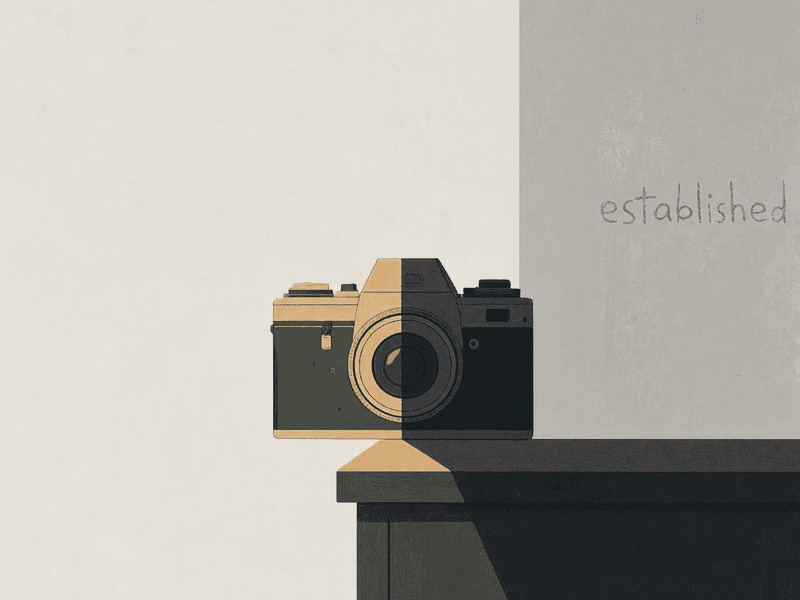
Compare the established tier and the asymmetry is severe. Painting 130. Sculpture 69. Installation 58. Ceramics 29. The establishment is still organized around the two disciplines the twentieth-century market elevated and paid for. The emerging cohort is organized around fourteen disciplines held in approximate equilibrium. Two different maps of what art is.
Supply-side data is more honest than demand-side data because it records decisions already made. A collector's taste can be talked into or out of a category by a fair week. An artist's practice cannot. A ceramicist has spent years on the wheel; a weaver has spent years at the loom. The 211 ceramicists and the textile-adjacent cohorts inside our emerging index represent labor already committed, studios already built, kilns already installed. Whatever the market decides to reward next, this generation has already chosen its hands.
Geography sharpens the picture. The Athenoir index shows the emerging cohort weighted toward the Middle East, Africa and Asia, which together form the majority, with the Americas at 1,583. The largest single-city cohorts include Nairobi at 165, Istanbul at 155, Jeddah at 107, Tel Aviv and Ankara at 101, Riyadh, Abu Dhabi and Dubai clustered in the mid-nineties, then Alexandria, Beirut, Lagos, Doha, Tokyo, Casablanca, Dakar, New Delhi, Cairo, Shanghai, Sharjah, Accra. These are cities with deep, uninterrupted material traditions — ceramic, textile, ornament, paper. In many of them the hierarchy that placed oil painting above craft was always an import, never a native ranking. The generation entering the market from these centers is not overturning a local order. It is declining to adopt a foreign one.
This is the mechanism worth naming. The death of the medium hierarchy in the West is often narrated as a critical achievement — decades of feminist scholarship, postcolonial curation, institutional revision. All true, all insufficient. The index suggests something blunter: the demographic center of contemporary art has moved to places where clay and thread were never demoted in the first place. The hierarchy did not lose an argument. It lost a census.
The pricing layer confirms that this is a real market, not a wishful one. Roughly 2,000 artists in our emerging index open below $5,000. The $5K–$10K and $10K–$50K bands absorb most of the remainder. The overwhelming majority of the emerging cohort is accessible below $50,000, a large minority below $5,000. A ceramic vessel and an oil painting at the same career stage now meet the collector at the same threshold. The material discount that once penalized craft — the assumption that a fired object should cost less than a stretched one — has no room to operate when the entry point is already flat.
What this does to the collector's habits is more interesting than what it does to prices. A buyer entering the emerging tier today confronts a field in which choosing ceramics over painting is not a countercultural gesture, not a specialist's detour, not a concession to decoration. It is one of fourteen roughly equivalent doors. The burden of justification has flipped. It is no longer the ceramicist who must explain why clay; it is the collector who must explain why not.
The institutional lag will resolve itself, slowly, in the direction the supply has already chosen. The established tier's concentration in painting and sculpture reflects a market that spent forty years rewarding those two mediums and pricing the rest as adjacent. When the emerging tier ages into the established tier — and 7,764 artists will not all disappear — the composition of the establishment will change by arithmetic alone. A future established cohort drawn from this emerging pool cannot possibly hold the 130-to-29 ratio between painting and ceramics. The numbers do not permit it.
There is a temptation to call this a craft revival. It is not a revival. A revival implies return, nostalgia, the reanimation of something dormant. The Athenoir index describes something else: a generation that never internalized the demotion, and therefore has nothing to revive. Clay was not waiting to be rescued. It was waiting for the people who ranked it to age out.
The lighthouse question for the next five years is not whether craft mediums will be taken seriously. That question has been answered by 211 ceramicists, 230 watercolorists, 222 collagists, and every textile practice folded into the mixed-media count. The question is which institutions will notice in time to matter, and which will keep hanging the same two mediums on the same two walls while the field they claim to represent has already reorganized itself around the kiln, the loom, the scissors and the brush of pigment on wet paper.