The speculative wave has receded, and the tide left something unglamorous on the sand: a medium. Not a revolution, not a death of authorship, not a new economy. A medium, roughly the size of ceramics.
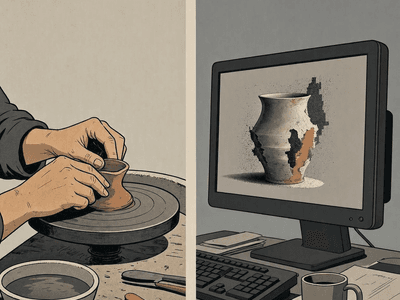
The Athenoir index tracks 212 emerging artists and 29 established artists whose stated practice includes AI. Generative art, its older and quieter sibling, sits at 209 emerging and 31 established. Set those numbers against the same index's counts for ceramics — 211 emerging, 29 established — and the comparison stops being rhetorical. AI art and ceramics are, statistically, the same shape of practice inside the working field. One of them spent the last three years on magazine covers. The other spent it in the kiln.
This is what normalization looks like when the confetti stops. The Athenoir index puts installation at 268 emerging artists, painting at 250, drawing at 241, mixed media at 238, photography at 234, sculpture at 232. AI and generative practices land just below sound art and just above video — inside the tail of legitimate, unglamorous, working mediums. Not the future. Not a fad. A tool a couple of hundred serious people are using seriously.
We should say, before going further, that this magazine uses AI in its own workflow, and has for some time. That disclosure is the price of writing honestly about the field. It also, we think, clarifies the argument. A publication that pretends to purity here is either lying or unemployed.
The hype cycle mattered less than its participants believe. For a brief period the discourse behaved as if a new medium had arrived to dissolve the old ones, and the counter-discourse behaved as if civilization were ending. Both positions required the same underlying assumption: that AI art was a movement. The Athenoir index does not support that. A movement, by any historical definition, reorganizes the practices around it. Painting did not shrink to accommodate AI. Sculpture did not concede. Photography, which absorbed a genuine technological shock a century and a half ago and emerged as a medium among mediums, offers the closer analogy — and even that overstates the case. What actually happened is that a category was added to the checklist. Artists ticked it, alone or alongside others. The index shows most emerging artists holding several practices at once; AI is one of the boxes now, next to collage and watercolor.
The established tier tells the same story in a lower register. Out of 1,643 established-tier artists in our database — 43 ultra-blue-chip, 543 blue-chip, 616 established, 441 mid-career — 29 work with AI and 31 with generative processes. Painting alone accounts for 130. This is not a suppressed avant-garde being kept from the top of the market. It is a medium with a normal, modest institutional footprint, roughly proportional to its footprint below.
What collapsed, then, was not the practice. What collapsed was the narrative surcharge — the premium the discourse charged for the word itself. With that gone, the work has to answer the ordinary questions. Is the image doing something an image should do. Is the artist thinking, or is the model thinking for them. Does the piece survive a second look, a third, a room it wasn't optimized for. These are the questions asked of a ceramicist, a watercolorist, a video artist. They are, at last, being asked here.
The geography of the emerging index matters to this argument. The Athenoir emerging cohort is not centered on the cities that hosted the AI-art hype cycle. Its largest concentrations are Nairobi at 165, Istanbul at 155, Jeddah at 107, Tel Aviv and Ankara at 101, Riyadh, Abu Dhabi and Dubai in the mid-nineties, Alexandria, Beirut, Lagos, Doha, Tokyo, Casablanca, Dakar, New Delhi, Cairo, Shanghai, Sharjah, Accra. The Americas hold 1,583 emerging artists in our database; the Middle East, Africa and Asia together form the majority. The people actually incorporating AI into a working practice are, disproportionately, working outside the cities where the medium was declared and then declared dead. This is worth stating plainly, because the obituaries were written in the same postal codes as the manifestos, and the practice continued elsewhere, unbothered by either.
Pricing corroborates the normalization. Among emerging artists in the Athenoir index, roughly 2,000 have a lower-bound entry price under $5,000. The $5K–$10K and $10K–$50K bands absorb most of the remainder. The majority of the emerging index is acquirable below $50K; a large minority below $5K. AI-native emerging work sits inside this distribution rather than above or beside it. The speculative pricing anomalies of the peak years — the ones that made the medium legible to people who don't otherwise read about art — are not visible in the working field. The working field is priced like the working field.
None of this is a verdict on quality. Normalization is not vindication. A medium the size of ceramics contains, like ceramics, a great deal of competent work, a smaller quantity of good work, and a very small quantity of work that will still be interesting in twenty years. The Athenoir index cannot tell you which is which. No index can. What it can tell you is that the frame has changed. We are no longer arguing about whether AI art is art. We are, finally, in the harder and more useful position of arguing about whether specific pieces are any good.
That is the position every medium eventually reaches, if it survives its own announcement. Photography reached it. Video reached it. Sound art reached it, quietly, while nobody was writing think pieces. AI art has reached it faster than expected, in part because the hype was so loud it exhausted itself, and in part because the artists kept working through the noise. The 212 emerging and 29 established practitioners in our index did not need the discourse to resolve. They needed it to end.
It has, more or less, ended. What is left is the studio, the model, the output, the edit, the decision, the room, the viewer. The same equipment every medium eventually gets down to. The work is now judged like everything else, which is to say: mostly it isn't very good, occasionally it is, and the difference is visible to anyone willing to look without an agenda. This magazine will keep looking. We will keep using the tools, and keep saying so. And we will keep asking the only question that survived the hype, which is the only question that ever mattered.